The airspace above the built environment beckons exploration, offering opportunities to discover overlooked spaces that have evaded the constraints of urban planning and the demands of the real estate market, which covet elevated panoramas. The creation of this intermediary realm between rooftops and the sky unveils pockets of an unseen landscape ripe with untapped potential. Le Théâtre de la Nuit explores the possibility of the roof as a space for artistic intervention. The proposed architecture is an urban interpretation of a theatrical stage, drawing patrons together to interact with the space and express their authentic selves. Cities cannot exist without considering their social component and Le Theatre de la Nuit not only embraces this idea but showcases it. The architecture of the redeveloped roofscape is an action and process that brings people together. In daylight, the projection screens are blank. At sundown the scenography awakes. Textiles strung between the façade openings display scenes from within the rooftop; microphones flood the street below with distinct whispers from above. The installation begins with the first act, the Outsider, allowing individuals to perceive the theater from afar, watching and listening from the outside. With their attention drawn, the second act debuts, the Spectator. Once immersed, one enters the third and final act, the Performer.
The airspace above the built environment beckons exploration, offering opportunities to discover overlooked spaces that have evaded the constraints of urban planning and the demands of the real estate market, which covet elevated panoramas. The creation of this intermediary realm between rooftops and the sky unveils pockets of an unseen landscape ripe with untapped potential. Le Théâtre de la Nuit explores the possibility of the roof as a space for artistic intervention. The proposed architecture is an urban interpretation of a theatrical stage, drawing patrons together to interact with the space and express their authentic selves. Cities cannot exist without considering their social component and Le Theatre de la Nuit not only embraces this idea but showcases it. The architecture of the redeveloped roofscape is an action and process that brings people together. In daylight, the projection screens are blank. At sundown the scenography awakes. Textiles strung between the façade openings display scenes from within the rooftop; microphones flood the street below with distinct whispers from above. The installation begins with the first act, the Outsider, allowing individuals to perceive the theater from afar, watching and listening from the outside. With their attention drawn, the second act debuts, the Spectator. Once immersed, one enters the third and final act, the Performer.
Re-Habitation Theodore Joliette.
Type: Sustainable Design System
Year: 2025
Context: Academic
Location: Hochelaga, Montréal
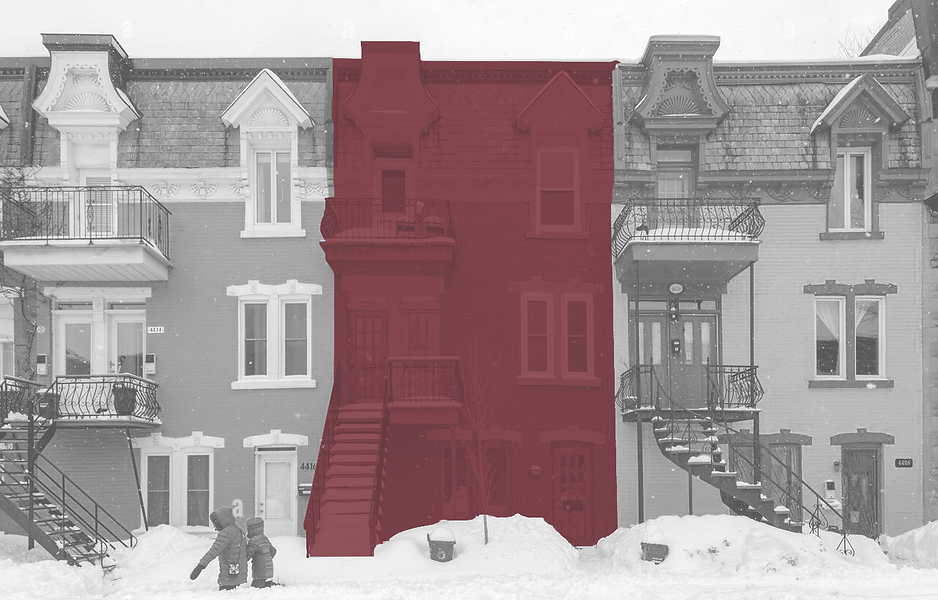
Between the late 1960s and mid-1990s, Québec launched one of Canada’s largest social housing efforts, building over 68,000 units under the Habitations à Loyer Modique (HLM) program. Over 80% of these were Multi-Unit Residential Buildings (MURBs), including nearly 2,800 walk-ups, plexes, and row houses. Constructed quickly and uniformly—with concrete foundations, wood frames, and brick cladding—these buildings became common in Montreal’s urban landscape. However, long-term environmental performance was overlooked. After 1995, as public investment declined, so did the condition of these homes. Today, 75% of Montreal’s 21,000 HLM units are in poor condition, plagued by leaky envelopes, drafts, and extreme indoor temperatures. Now, their future demands urgent attention. Re-Habitation Joliette responds to this need by reimagining the iconic Montreal triplex typology. The project addresses both the housing crisis and climate emergency through targeted thermal retrofits. Combining passive and active systems, it assesses site-scale energy impacts to promote resilience, sustainability, and adaptability in today’s housing market.
Project Gallery


